Quick answer A prompt asks an AI for one answer; a task gives an AI employee an outcome to own. I don't write perfect prompts anymore. I give my AI employees tasks in plain words, the way I talk to my team. They pick up my tone and adjust. The skill is training them right.
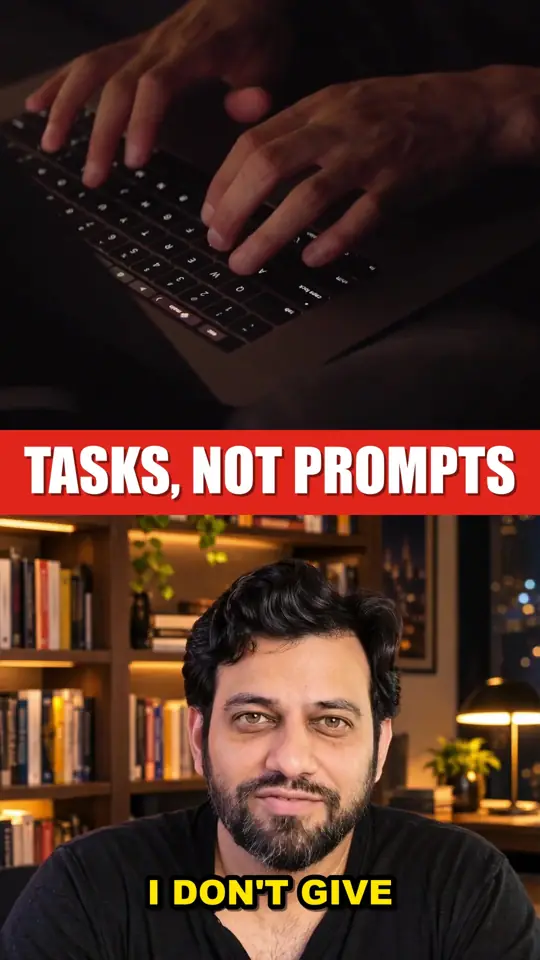 Watch the reel
I stopped writing prompts
For a while everyone was collecting prompts. Long templates. Magic phrases. "Act as a world-class marketer." Courses on prompt engineering.
I don't do that anymore. I give tasks.1
No fuss. I talk to my AI employees the way I talk to my team. One short line, in plain words, about the outcome I want.
They read the room
Here is the part that still surprises me. They get my tone. They can tell when I'm happy, and when I'm angry. A short, sharp message gets a different response from a relaxed one. And they adjust to it.2
That is what a good new hire does in the first month. They learn how the boss writes, what "urgent" really means, and which details matter.
Prompt vs task: the difference
| Prompt | Task | |
|---|---|---|
| What you give | Instructions for one reply | An outcome to own |
| Who does the thinking | You, in the wording | The AI employee, within its job |
| Context | Pasted in every time | Your live business data |
| What you get | Text | Work done, plus a report |
It's not about the perfect prompt. It's about training them right, so they adapt to you.
What this means for your business
- Stop optimising wording, start defining jobs. Write down what each AI employee owns, the same way you would for a human role.
- Give feedback like a manager. When the result is off, say so plainly. That correction is the training.
- Keep the gate on risky work. Plain-language tasks make it easy to delegate, which is exactly why money and customer-facing actions should still wait for your approval. See why a Confirm button matters.
How ZNOS handles this
In ZNOS each AI employee owns a real job and works from the company's live data through the Brain. Routine work runs on its own. Money moves, customer messages and anything said in your name wait for your approval, and every action lands in an audit log that shows who changed what. Meet the roles on the ZNOS AI team.
For what giving an AI a task looks like in practice, read how one instruction turned into a night of SEO fixes, or the guide what are AI employees.
Frequently asked questions
What is the difference between a prompt and a task for AI?
A prompt is wording that asks a model for one reply. A task is an outcome you hand to an AI employee that has a job, access to the data it needs, and a person it reports to.
Is prompt engineering still needed?
For AI employees that already know their job and your business data, much less. Plain-language instructions and good feedback matter more than clever wording.
How do you train an AI employee?
The same way you train a new hire: give clear tasks, correct what is wrong in plain words, and let it learn your tone and standards over time.
Can AI understand tone?
Language models respond to tone in text. In Adi's experience, his AI employees can tell a happy message from an angry one and adjust their response.
What tasks should still need approval?
Anything that moves money, messages customers or is published in your name. In ZNOS those wait for a human approval and every action is logged.
- Adi, "I Don't Give AI Prompts Anymore. I Give Tasks." (YouTube Short, 29 Oct 2026): https://youtube.com/shorts/Fdyl-zdVUS8
- Adi on LinkedIn, 29 Oct 2026: prompts vs tasks (carousel): https://www.linkedin.com/feed/update/urn:li:ugcPost:7521302319246848000/
- Adi on X, 29 Oct 2026: https://x.com/adnyesh/status/2115647312416636932