BLOG · PERSPECTIVE · AI ADOPTION
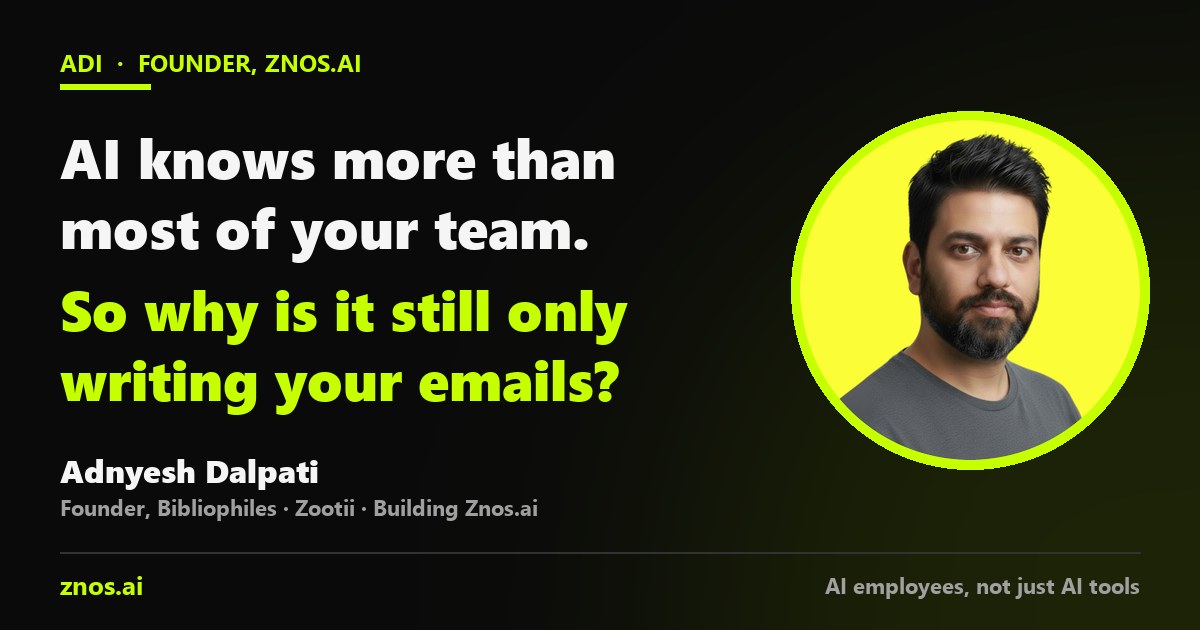
AI Knows More Than Most of Your Team. So Why Is It Still Only Writing Your Emails?
ChatGPT arrived in November 2022. Claude followed a few months later. That's almost four years with the most knowledgeable tools most of us have ever had.
And what do we use them for?
A polite reply to an angry email. A summary of a 40-page PDF. A formula for the Excel sheet that refuses to behave. "Explain this to me like I'm five."
That isn't just my impression. A 2025 study of a representative sample of ChatGPT conversations (NBER, "How People Use ChatGPT") found that three topics (practical guidance, seeking information and writing) make up nearly 80% of all conversations. More than 70% of messages weren't even about work.
Companies show the same pattern. McKinsey's State of AI 2025 survey found that 88% of organisations now use AI regularly in at least one business function, yet only about one-third have begun to scale it, and just 23% are scaling AI agents anywhere in the business (McKinsey).
So the most well-read "employee" in history is mostly being used as a very smart search box and a typist.
It's not because AI isn't capable
Let me be clear. AI has read more than any of us. It can draft a legal notice, analyse a P&L, write code and explain GST rules better than many people I've hired.
The problem isn't knowledge. The problem is how it works with us.
Today's AI waits. You ask, it answers. You check it. You copy it into another tool. You come back and ask the next thing. Every single step needs a human in the middle: to give context, to press the button, to chase the follow-up.
That isn't an employee. That's an intern who needs you standing behind them all day.
I know that feeling well, because that's exactly where this started for me.
The problem I actually had
Running a D2C brand is not easy.
I've hired good people. They learned our systems, our customers, our quirks. Then, just as they became truly useful, they left. The knowledge walked out of the door with them, and I started again: job post, interviews, onboarding, months of learning.
Good talent is expensive to find and even more expensive to keep. For a growing brand, that cycle is painful, and it's the founder who ends up firefighting in between.
So I ran an experiment. Instead of asking "how can AI help my team?", I asked:
👉 "What would it take for AI to be part of the team?"
The gap we found
When I give a task to a remote employee, I don't tell them which buttons to press. I say "get this campaign live by Friday" or "follow up with these 40 leads". They work out the steps, do the work and come back with it done, or with a sensible question.
There was no reason an AI employee couldn't work the same way. It also had to feel natural. No prompt engineering, no templates, no "act as a marketing expert". You should be able to open a chat or pick up the phone and just talk, the way you'd brief a colleague, and the work should simply move forward from there.
The gap was never intelligence. It was training: teaching AI to understand a role, take an instruction, plan the steps, finish the job end to end and report back like a colleague.
Once we closed that gap, something interesting happened. From the outside, you couldn't tell whether a task had been done by a remote human or by an AI employee. Both took instructions. Both delivered. The person on the other side of the chat or the call didn't know, and didn't need to.
I believe that's where the world is heading. Very soon, nobody will know (or care) which part of the work was done by a person and which by AI.
What that looks like in practice: Znos
That experiment became Znos.ai.
Znos is an AI operating system that runs in your brand's own private space. Inside it, you get a team of AI employees, each already trained for its job, working on its own and thinking about what's best for your brand.
They don't just recommend. They do the work end to end:
- Social media: ideas, creatives, captions and posting.
- Organic traffic: content and SEO, week after week.
- Paid ads: launching, watching and improving campaigns.
- Leads: finding them, following up and helping close.
- Finance: the nitty-gritty of invoices, reconciliations and reports.
- People: following up with your human team, the way a good manager would.
Your role changes from doing to deciding. They bring the plan and the work; you give a go or a no-go.
Why this is bigger than another chatbot
Most AI products today are features: a smarter text box inside software you already use. Useful, but you're still the one driving.
The real shift is from tools you operate to colleagues you manage. Plenty of companies are chasing it. Znos.ai is one of them, trying to bridge this gap and making AI employees work so naturally that you stop noticing they're AI. From what I see in our own brands every day, I believe we're further down that road than most.
The lesson
If your AI usage today is emails, summaries and spreadsheet formulas, you're not doing it wrong. You're just using a genius as a typist.
The better question isn't "what can AI write for me?" It's:
👉 "What job could AI do for me, start to finish, so I only have to say yes or no?"
That's the question I started with. Znos is my answer.
If you're a founder stuck in the same hire–train–lose cycle, I'd genuinely like to hear how you're handling it.
See how AI employees work → znos.ai
Sources
- OpenAI, "Introducing ChatGPT" (30 Nov 2022)
- Anthropic, "Introducing Claude" (14 Mar 2023)
- McKinsey, The State of AI in 2025 (survey of 1,993 respondents, Jun–Jul 2025)
- Chatterji, Cunningham, Deming et al., "How People Use ChatGPT", NBER Working Paper 34255 (2025)
NBER 34255 figures used: ChatGPT reached about 10% of the world's adults by July 2025; non-work messages grew from 53% to over 70%; practical guidance, seeking information and writing make up about 80% of conversations.
Related: AI employees: boon or curse? · What are AI employees? · Znos vs ChatGPT / Claude · What AI employees can and can't do · All articles
About the author
Adnyesh (Adi) Dalpati · Founder, ZNOS
Founder of ZNOS, where brands recruit an AI team. Uses ZNOS every day to run a direct-to-consumer brand.
Follow AdiLinkedInX @adnyeshInstagram @adnyeshFollow ZNOSX @znos_ai
Currently invite only. Curious what AI employees could take off your plate? Tell Sophia about your work.
Talk to Sophia